
Boaz: A friend of sinners
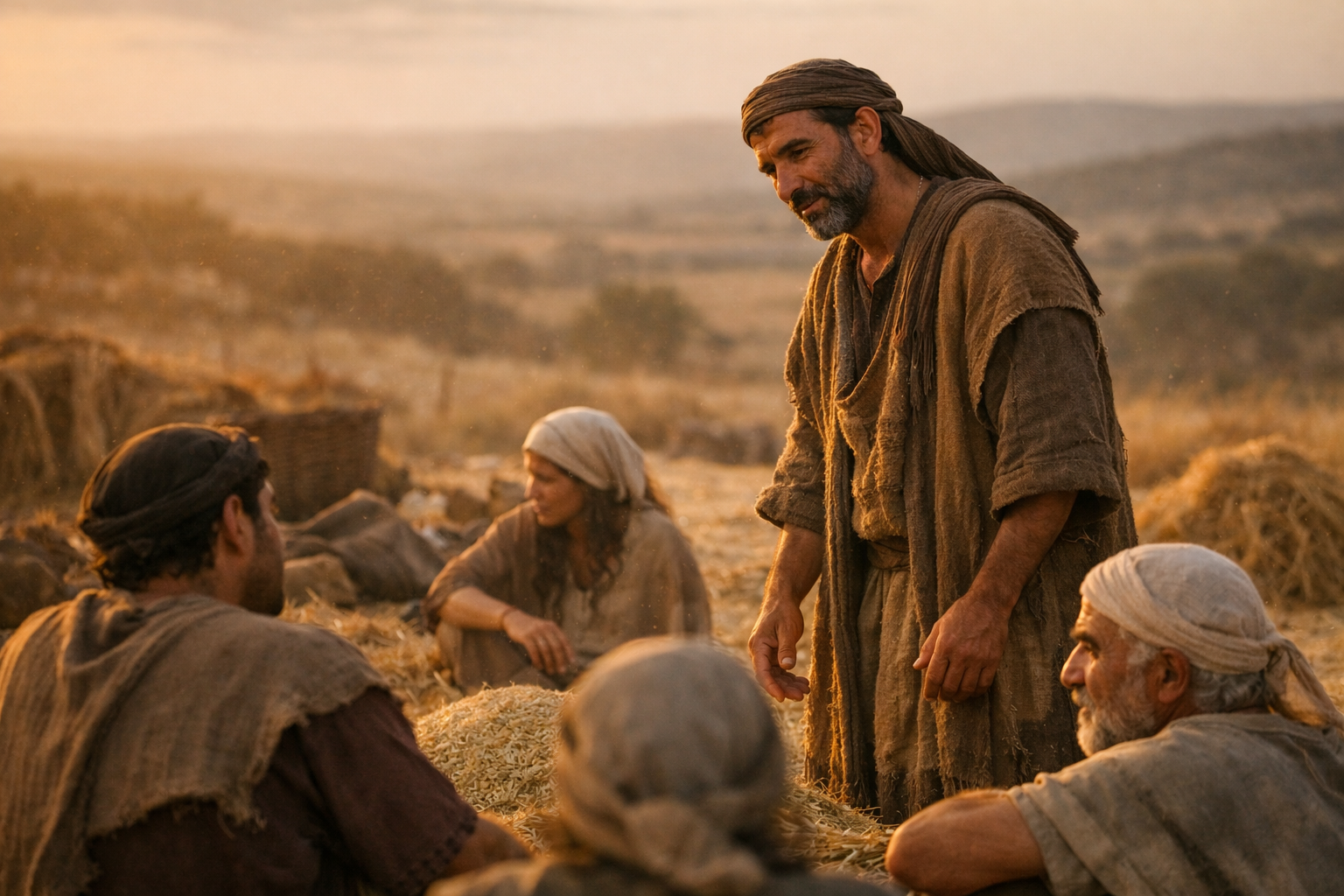
Ruth 2:4
4 And behold, Boaz came from Bethlehem. And he said to the reapers, “The Lord be with you!” And they answered, “The Lord bless you.”
Boaz moved among his workers with steady attention, ensuring the harvest ran smoothly as they gathered and threshed the grain. His presence conveyed practical leadership and compassionate oversight, respectful of both the work and the people doing it. As night fell and the labor ended, per local custom, only the workers would sleep on the threshing floor. Boaz joined them. Alone under the open sky, Boaz reflected on the day’s toil and the needs of his household, trusting that God’s provision would continue to bless the fields, the workers, and whatever future arrangements divine wisdom might bring.
Boaz was a prominent figure in the Old Testament, known for his role in the Book of Ruth as a wealthy landowner who exemplified integrity and kindness. He observed the laws of gleaning (leaving left-over crops for the poor), protected and honored Ruth, and ultimately acted as her kinsman-redeemer by marrying her and preserving the family line of Naomi and Ruth. His character is often highlighted for combining compassion and humility. He acknowledged Ruth’s loyalty, ensuring her safety and provision in his fields. Boaz’s faithfulness and wise stewardship not only restored dignity and security to Naomi and Ruth, but also placed him in the genealogy of King David and consequently, the lineage of Jesus. So, why is Boaz important?
Boaz lived during the turbulent time period of the Judges, a time marked by social and economic instability, moral decline, and repeated cycles of idolatry, much like the time of Jesus. In this light, Boaz can be viewed as a foreshadowing of Jesus, who left the heavenly throne and came down to earth. Much like Jesus, Boaz abandoned the security and privilege of his social status to move toward the poor, the dispossessed, and the outcast, exercising gracious mercy rather than asserting his authority and power. He personally went out to the fields to meet the reapers (Ruth 2:4) , he had his meals with them (Ruth 2:14), and slept with them on the the threshing floor (Ruth 3:7). And the parallel here is found in Philippians 2:6-7 (6 Who, being in very nature God, did not consider equality with God something to be used to his own advantage; 7 rather, he made himself nothing by taking the very nature of a servant, being made in human likeness.)
And again, we have to ask ourselves, what does this have to do with Ruth? Ruth, a Moabite and therefore a Gentile by birth, entering into marriage with Boaz, a Jew, powerfully illustrates the New Testament theme of God’s inclusive plan in Romans 3:32 (32 This righteousness is given through faith in Jesus Christ to all who believe. There is no difference between Jew and Gentile). Her story shows that God’s covenant blessings are not limited by ethnicity or national origin. Through Ruth’s faithfulness and loyalty, she is grafted into Israel’s community and lineage, becoming both part of God’s people and an ancestor of King David and ultimately the Messiah. In this way Ruth embodies how God moves from particular covenant promises given first to Israel toward a wider redemption that embraces outsiders. This demonstrates that faith and devotion opens the way for participation in God’s redemptive purposes “to the Jew and the Gentile.”
Prayerful Thought….
19 The Son of Man came eating and drinking, and they say, ‘Here is a glutton and a drunkard, a friend of tax collectors and sinners. ”But wisdom is proved right by her deeds.” Matthew 11:19
And Remember…….
“ You cannot get to the end, without being changed by the journey” -Dr Lee